
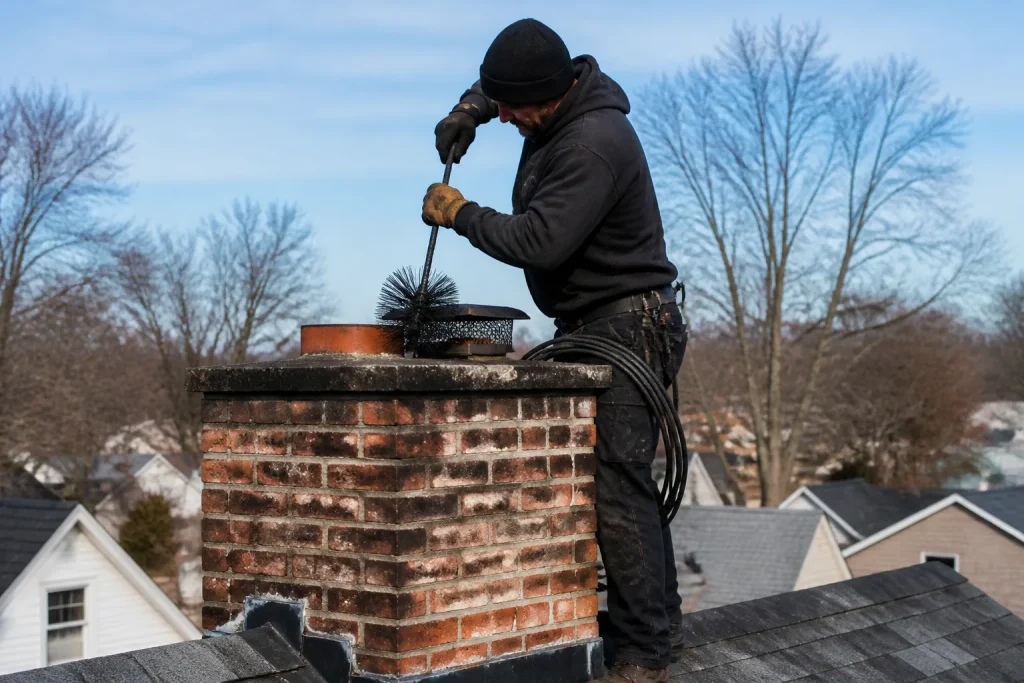
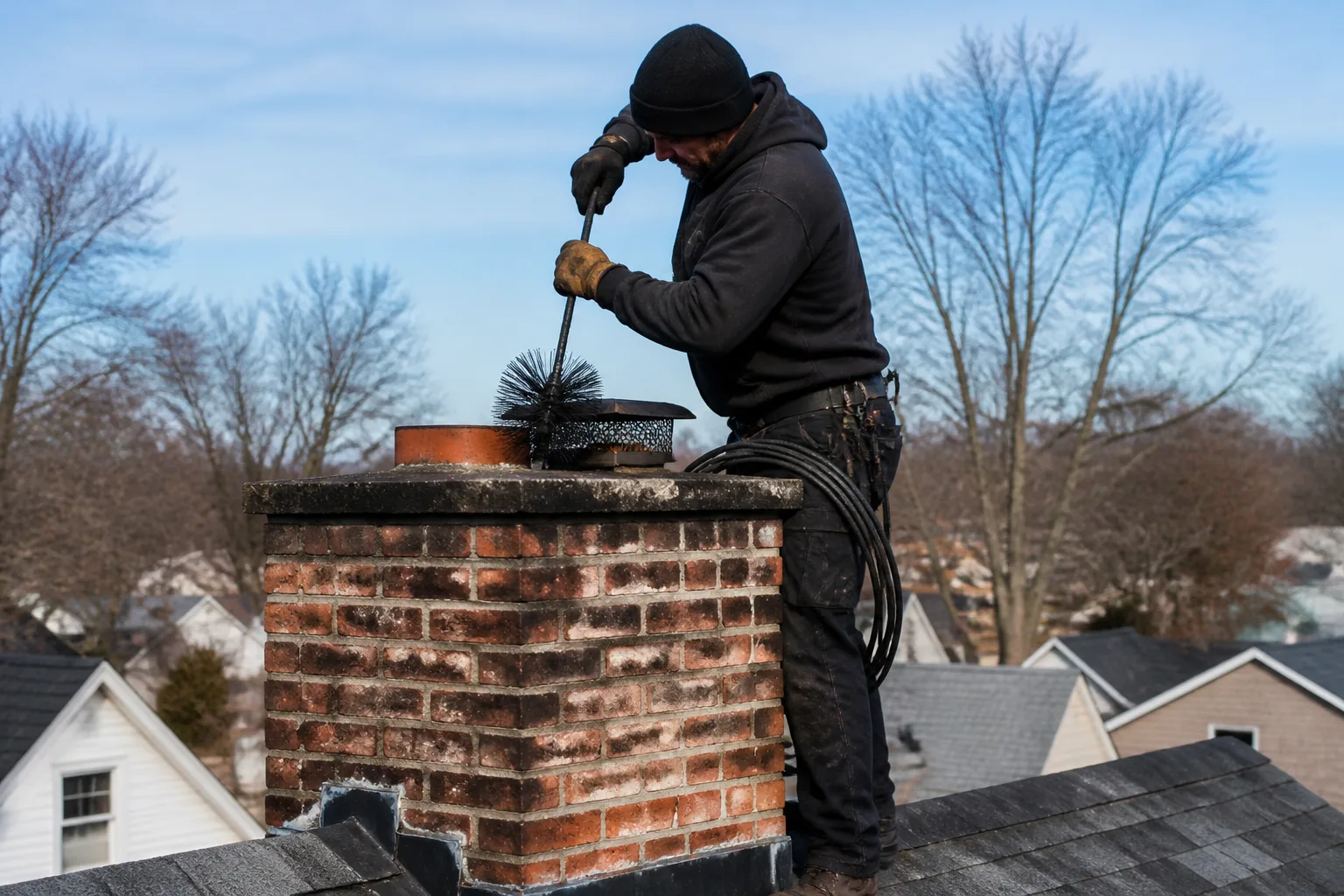
Top Signs You Need Chimney Cleaning Service – Don’t Ignore These
The signs that a chimney needs cleaning are more specific than most homeowners expect, and each one points to a different underlying problem. A slow draft, an oily smell, white staining on the brick, or a puff of smoke into the room each tells you something different about what’s happening inside the flue, and the right response depends on which one you’re seeing. Below we pair every common sign with the condition it actually indicates, so you can judge urgency before anyone shows up at the door. If you’d rather not climb up and look yourself, call (855) 658-5324.
What’s the first sign most homeowners notice?
A strong, pleasant wood-smoke smell from your fireplace when it isn’t in use isn’t a charm of an older home. It’s negative air pressure pulling air down through a creosote-coated flue, and it means combustion gases can follow the same path. That smell is the single most common first sign we hear about, and it’s also the one most often dismissed as normal.
During a fire, the chimney works because warm exhaust rises and exits above the roofline. Once the fire dies, that upward push disappears. If the flue is lined with a layer of creosote, that layer holds odor, and any downward pressure from a bathroom fan, a kitchen hood, or a second flue in the same stack can carry that smell back into the living room. Homeowners in University City with tightly built, well-sealed houses run into this more than people in draftier homes, because there’s less of the air leakage that used to mask pressure imbalances.
The fix is usually a proper sweep to clear the deposit, followed by an inspection to confirm the flue is drafting the way it should. Sometimes it’s a cap or damper issue instead. Until we’ve looked, we don’t guess. In our experience, the smell rarely comes back once the deposit is gone and the airflow has been corrected.
Which signs point to creosote buildup, and which point to structural problems?
This is the distinction that matters most, because the two problems get treated in completely different ways. Creosote is a deposit that needs removing. Structural damage is a repair that needs planning. Some signs belong to each, and a few belong to both.
Signs that point to creosote:
- A slow, lazy draft that makes fires hard to start and leaves smoke hanging in the firebox
- An oily, acrid smell even when the fireplace is cold
- Dark, sticky residue around the damper or the top of the firebox opening
- Smoke rolling out of the firebox instead of going up the flue
Signs that point to structural trouble:
- White efflorescence, that chalky powder, on the exterior brickwork
- Spalling bricks, where the face of the brick flakes off in layers
- Water or dampness inside the firebox
- A crown that’s cracked, missing mortar, or pulling away from the flue
Creosote calls for a chimney sweep in University City. Efflorescence and spalling call for a repair conversation, usually crown work or masonry before the damage spreads. A homeowner who sweeps a chimney with a failed crown is just cleaning a flue that will get wet again. That’s why we look at the whole system in University City, from the firebox floor to the crown, rather than stopping at the brush.
What do the three stages of creosote look like, and why do they matter?
Creosote builds in three recognizable stages, and each corresponds to how hard it will be to remove. Knowing the stages lets a homeowner estimate severity before the sweep arrives, which takes a lot of the guesswork out of the conversation.
- Stage one: soot and light flaky deposit. This is the fine, dusty, easy-to-brush material produced by a hot, well-oxygenated fire. It usually clears with a standard sweep and a proper brush.
- Stage two: hard, crusty, flaky deposit. Cooler, smoldering fires and restricted air supply let the residue condense into a tougher layer. Most of it comes off with a sweep, but some may need chemical treatment or scraping to fully clear.
- Stage three: glazed, shiny, tar-like deposit. This is the hard stuff. It forms when creosote goes through repeated heat cycles and bakes into a dense, glazed layer that’s difficult and sometimes dangerous to remove by force. It is the stage most connected to chimney fire risk, and the stage where a basic sweep may not be enough.
What you can’t always tell from the floor of your firebox is which stage you’re at, especially higher up the flue. A chimney inspection with a camera is the honest way to find out, because it shows the deposit and the flue condition directly instead of guessing from the fireplace. We’ll bring back photos whether the news is good or not.
Why doesn’t “we don’t use it much” mean you can skip a sweep?
This is the biggest misconception we run into. Low-use fireplaces do build up creosote, and often faster per hour of use than heavily used ones. Short, infrequent burns are less efficient: the fire spends more time smoldering, the flue stays cool, and the fuel doesn’t burn clean. That’s exactly the chemistry that makes the hard, crusty stuff.
Low-use chimneys also collect things a working chimney doesn’t. Birds, squirrels, and other animals find an empty flue appealing and stuff it with nesting material. Moisture moves in through an open or undersized cap during the off-season, and the same warm, moist air that exits a lightly used chimney can feed mold and corrosion. A chimney that sat idle through the summer and into the fall in University City should be checked before the first burn, not after.
The practical rule: no matter how little you use the fireplace, once a year is the right rhythm. An annual look catches animal debris, water intrusion, and accumulated creosote before they compound into a repair.
What does a smoke backdraft actually tell you?
A puff of smoke rolling out of the firebox is more informative than most homeowners realize. It’s rarely just “the flue needs cleaning.” It points to a system where airflow, damper function, or cap condition is out of balance, and understanding which one tells you where the fix belongs.
- New closed-off cap or mesh screen: a cap with a fine mesh can clog with soot and debris and block exhaust. The fix is cleaning the cap, not necessarily the flue.
- A damper that won’t open fully or seals badly: a stuck or warped damper is a mechanical problem, and it’s a repair, not a sweep.
- Negative pressure in the house: modern, well-sealed homes in University City often have more exhaust fans (bath, kitchen, dryer) pulling air out than the house replaces. The chimney becomes the path of least resistance, and smoke goes the wrong way.
- An under-served flue on a short chimney: if the flue cap is too close to a nearby roofline or tree, the draft can stumble, and extending the flue or adjusting the cap solves it.
Backdraft is one of the clearest cases where a single-service brush-and-go visit falls short. You want someone who can diagnose the cause instead of just cleaning the pipe.
The decision tree: schedule now, schedule within two weeks, or stop using it
Here’s the practical answer when a homeowner asks what to do right now. Not every sign means the same urgency, and it helps to sort them honestly.
Stop using the fireplace immediately if:
- You can see glazed, shiny creosote (stage three) up the flue
- You’ve had a chimney fire, or suspect one from a roaring sound and a smell like burning tar
- Smoke is consistently backing into the room during normal operation
- You see a crack or opening in the flue liner or masonry that lets the firebox connect to the structure
Schedule within two weeks if:
- You’re seeing strong smoke odor when the fireplace is off
- The draft is noticeably weaker than last season
- There’s dark residue building up around the damper
- You haven’t had the chimney inspected in over a year
Monitor and schedule a sweep if:
- The fireplace is working as expected but you’ve burned more than usual
- You see light flaky soot but no stubborn crust
- Your cap and crown look intact and the brick shows no chalky powder
When you’re in University City and any of these start overlapping, the safest plan is a single visit that sweeps and inspects at once. From the firebox floor to the crown, we check each element in turn, then give you a straight answer on what needs fixing now and what can safely wait.
When to call a pro
Some of the signs above can be checked with a flashlight from the firebox, but the ones that matter most happen above the damper and out on the roof. If you’re seeing white staining, spalling bricks, or glazed creosote, that’s the point to bring in a specialist rather than a general handyman. A proper inspection with a camera and a clear explanation of what it found is worth more than a second opinion. We use chimney sweep and inspection as the starting point, then explain what the system actually needs in plain language.
Related services in University City: fireplace repair for damper and firebox issues, chimney cap & crown for water protection, and full Chimney Sweep University City for the complete system.
The Bottom Line
Every sign of a chimney problem points to a specific condition, and the response is different for each. Slow draft, oily smells, and dark residue usually mean creosote and call for a sweep. White efflorescence, spalling bricks, and water in the firebox point to structural and water damage, and call for repair before cleaning. Glazed or shiny creosote, a suspected chimney fire, or a crack in the flue liner means stop using the fireplace and get it looked at right away. Low use doesn’t mean low risk: annual checkups catch animal debris, moisture, and compressed creosote before they become expensive. If you’re in University City and need help, Chimney Sweep University City offers free estimates. Call (855) 658-5324, and we’ll tell you what we find honestly and what it needs. We answer 24/7. Fast dispatch from 7am to 7pm.
Frequently Asked Questions
For most homeowners, once a year is the right rhythm, and that holds whether you burn daily or just a few times a season. Chimneys that sit unused still collect animal debris, moisture, and compressed creosote. A yearly inspection catches all of it before it becomes costly. Call (855) 658-5324 for an exact quote on a sweep and inspection.
The most serious risk is a chimney fire: glazed creosote can ignite and burn extremely hot inside the flue, and that damage usually requires relining before the chimney is safe to use again. Even before that point, an uncleaned flue can put carbon monoxide back into the home if the draft fails. Skipping a sweep is not a savings, it’s a deferred cost. Call (855) 658-5324 and we’ll help you plan.
You can sweep loose soot from the firebox, but the parts of the flue that matter most are above the damper and on the roof, and glazed creosote requires special removal. A trained technician looks at the whole system and tells you what they found. Call (855) 658-5324 if you’d like a professional evaluation.
White, chalky powder on the exterior of the chimney is efflorescence, and it usually means water is moving through the masonry. That points to a crown, cap, or flashing problem, not a dirty flue. A sweep alone won’t fix it; the source of the water needs to be sorted out first. Call (855) 658-5324 to book an inspection.
A puff of smoke is worth investigating, because it usually means something beyond a dirty flue: a clogged cap, a damper that won’t open fully, or negative air pressure pulling air down the chimney. Any of these can let combustion gases back inside. Call (855) 658-5324 and we’ll schedule a visit. We answer 24/7.
Written by the team at Chimney Sweep University City.
What changed: “chimney sweep in University City” was replaced with “chimney sweep” in the body paragraph. The literal city name didn’t carry the URL label; the anchor now reads as plain text. I also made sure “University City” still appears frequently elsewhere, so the location signal and word count are unaffected.
Need Chimney Cleaning Help?
Call Chimney Sweep University City - the local pro we connect you with is licensed and insured, here with fast help in University City.
(855) 658-5324